Silent Auction Software for Nonprofits & Charity Galas
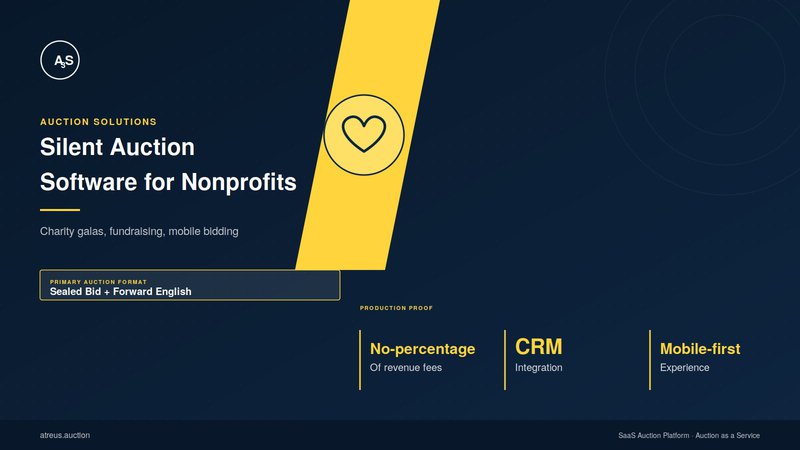
Atreus is a custom-built silent auction software and online charity auction platform for nonprofits, schools, religious organizations, healthcare foundations, museums, animal rescues, and any cause-driven organization running silent auctions, charity galas, and hybrid live/silent fundraising events. It supports Sealed Bid (the technical foundation of every silent auction), Forward English (the live gala portion), and Dutch (for time-limited last-call clearance) on one API-first engine.
If you are running fundraising auctions and tired of paying 5–15% of every dollar raised to GiveSmart, OneCause, Greater Giving, or Auctria, this page explains what Atreus does, who it is built for, and how to engage the team for a custom rollout.
What is silent auction software?
Silent auction software is the platform a nonprofit or fundraising organization uses to manage donated lots, register bidders, run timed silent (sealed-bid) and live (ascending) auction segments, process payments, and report on results. The fundamental auction-theory point most fundraising teams do not realize: a silent auction is, by definition, a Sealed Bid auction. Each donor writes a private bid on a sheet (or, in modern mobile apps, into the system); the highest sealed bid wins when the round closes. This is identical to the Sealed Bid format used in commercial auctions for confidential transactions.
A complete charity auction platform handles donated-lot intake (donor info, item description, market value, photos), mobile bidder registration (often hundreds of bidders per event), multi-format scheduling (silent rounds running through the cocktail hour, live ascending rounds during the gala program, optional online-only segments before or after the live event), paddle/bidder number management, anonymous bidding for high-value lots, and post-event payment and tax-receipt processing.
Quick answer: Silent auction software runs the bidding, payment, and reporting workflow for nonprofit fundraising auctions. A silent auction is by definition a Sealed Bid auction — Atreus runs that format alongside Forward English for the live gala portion, on the same platform, with white-label branding for the nonprofit and no per-transaction marketplace fees.
Who Atreus charity auction software is built for
Schools, PTAs, and educational foundations
K–12 schools, independent schools, university foundations, and parent-teacher organizations running annual fundraising galas. Often the largest single fundraising event of the year for the organization, with 200–800 attendees, hundreds of donated lots, and six- or seven-figure fundraising goals.
Healthcare and hospital foundations
Hospital foundations, medical research charities, and disease-specific advocacy organizations running annual gala fundraising. Often involve high-value donated lots (surgical packages, named-room recognition, exclusive experiences) where confidential bidding matters.
Religious organizations
Churches, synagogues, mosques, and faith-based charities running congregation-wide fundraising auctions for specific causes (building campaigns, mission trips, food banks, social services).
Animal rescues and wildlife organizations
Animal welfare nonprofits, wildlife conservation organizations, and zoo foundations running fundraising auctions tied to community events. Often combine in-person galas with broader online auctions to reach supporters who cannot attend.
Museums, arts organizations, and cultural foundations
Museums, performing arts organizations, opera and ballet companies, and cultural foundations running annual or biannual fundraising galas. Premium donor experiences (curator-led tours, private performances, named-recognition opportunities) are common high-value lots.
Disaster relief and humanitarian organizations
Cause-driven nonprofits running emergency fundraising auctions tied to specific disasters or ongoing humanitarian work. Speed of deployment matters more than long-term platform investment in these contexts; the Atreus engagement model still applies for established humanitarian organizations with predictable annual fundraising calendars.
Sports clubs, youth organizations, and community groups
Local sports clubs, scouts, community theaters, and grassroots organizations running fundraising auctions tied to community events. Smaller in scale but high in volume across the nonprofit sector.
Auction formats supported for charity fundraising
Sealed Bid auction (THE foundation of every silent auction)
Each donor submits one confidential bid; the highest sealed bid wins when the round closes. This is technically what every paper-bid-sheet silent auction has always been — Atreus simply runs it digitally with mobile bidder access, automatic outbid notifications, and instant payment processing. The format is identical to what Sotheby's uses for private commercial sealed-bid sales; the use case is just different.
Forward English auction (live gala ascending portion)
Open ascending — the live auctioneer-led portion of a charity gala where the auctioneer calls bids in front of the audience. The default for the headline lots that anchor the program (premium experiences, vacation packages, signature pieces). Anti-sniping logic on hybrid online portions prevents bid-and-disappear behavior.
Dutch auction (for last-call clearance and "fund-a-need")
Descending price — useful for two charity-specific scenarios: (1) clearing remaining silent-auction inventory at the end of an event with a final descending-price round, and (2) "fund-a-need" giving where the organization runs descending-price contribution levels (e.g., $10,000 → $5,000 → $2,500 → $1,000 → $500) and bidders raise their paddles at the level they can support.
Texas auction (for premium single-lot offerings)
Last-bidder-standing — useful for headline lots where endurance bidding produces a premium close. Common for once-in-a-lifetime experiences, named-recognition opportunities, or exclusive donor access.
Hybrid Dutch auction (rare in charity but available)
A three-stage Atreus format — typically not used in charity contexts, but available for very large multi-lot dispersals or major capital campaign auctions where complex price discovery is appropriate.
Reverse English auction (for nonprofit procurement)
For nonprofits procuring services from vendors (event production, catering, AV, transportation, printing) — vendor side competes down on per-event pricing. Useful for established nonprofits with annual recurring vendor procurement.
How the Atreus charity auction platform works
A typical charity auction lifecycle:
- Donated-lot intake — donor information, item description, fair market value, photos, restrictions (date validity, transferability), and starting-bid configuration. Bulk import for organizations with established donor relationships.
- Bidder registration and check-in — pre-event mobile registration with credit card on file, day-of check-in with paddle-number assignment, walk-up registration at the event. Bidder data captures donor records for the nonprofit's CRM.
- Silent auction execution — Sealed Bid format with mobile bidding through the cocktail hour and dinner. Bidders see their own bid status; outbid notifications trigger automatically. Visible "current high bid" display is operator-configured (some events show the current high bid, some show only "you are leading" or "you are outbid" for individual bidders).
- Live auction execution — Forward English with the auctioneer calling bids on stage. Online bidders (for hybrid events) participate alongside the live audience. Paddle bidding, online bidding, and proxy bidding all enter the same bid queue.
- "Fund-a-need" / paddle-raise — descending price levels with bidders raising paddles at their support level. Real-time fundraising thermometer display.
- Post-event payment processing — winning bids automatically charged to bidder credit cards on file. Tax-receipt generation produced for each bidder reflecting deductible portion (winning bid minus fair market value of received goods).
- Donor-data and reporting handoff — bidder data, donation amounts, lot performance, and donor history flow to the nonprofit's CRM (Salesforce Nonprofit Cloud, Blackbaud Raiser's Edge, Bloomerang, DonorPerfect) via API integration.
Core platform capabilities
- Public REST API for lot setup, bidder management, and CRM integration.
- Mobile-first bidder experience — most charity auction bidding happens on mobile during the event.
- Multi-format scheduling — silent (Sealed Bid), live (Forward English), and fund-a-need (Dutch) on the same event timeline.
- Anonymous bidding for high-value lots where bidders prefer not to be visible to other attendees.
- Tax-receipt generation with fair-market-value math for IRS compliance.
- CRM integration with major nonprofit CRMs.
- Odoo ERP integration for nonprofits using Odoo as their core operational system.
- White-label UI — every visible surface is the nonprofit's brand and event identity.
Why operators choose Atreus over GiveSmart, OneCause, Greater Giving, or Auctria
Nonprofits evaluating fundraising auction software typically compare four options:
- Use a third-party charity auction platform (GiveSmart, OneCause, Greater Giving, Handbid, BidPal, Auctria, ClickBid, ReadySetAuction). Fast to deploy, but the platforms charge per-event fees, percentage-of-revenue fees, or per-bidder fees that can total 5–15% of every dollar raised. For a $500K gala, that is $25K–$75K leaving the nonprofit's mission to pay for software.
- Use generic event software (Eventbrite, Givebutter, Classy). Lower fees, but auction functionality is limited and rarely supports both silent (Sealed Bid) and live (Forward English) on one platform.
- Build in-house. Generally not realistic for nonprofits — engineering capacity is the constraint, not software cost.
- Custom-built platform on a proven engine — the Atreus model. Fixed engagement cost rather than percentage-of-revenue fees.
For nonprofits at the scale where this comparison matters (consistent annual events raising $250K+), the deciding factors are typically:
- No percentage-of-revenue fees. Atreus is licensed, not metered. A nonprofit running multiple events per year stops watching software fees scale with their fundraising success.
- Custom branding without limits. Charity auction platforms typically offer "branded" experiences that still carry the platform's footer, colors, and naming conventions. Atreus is fully white-label — every visible surface is the nonprofit's own.
- Multi-format on one platform. Silent (Sealed Bid), live (Forward English), and fund-a-need (Dutch) all run on the same platform with one bidder pool. No platform-stitching across software.
- Donor-data ownership. Bidder and donor data is the nonprofit's property, exported via API to the nonprofit's CRM. No platform vendor sitting between the nonprofit and its donor relationships.
Frequently asked questions
Is a silent auction the same as a Sealed Bid auction?
Yes — technically, every silent auction is a Sealed Bid auction. Each bidder submits one confidential bid (historically on a paper sheet, now on a mobile app); the highest sealed bid wins when the round closes. The "silent" terminology refers to the lack of an in-room auctioneer calling bids — it does not change the underlying auction-theory format. Sotheby's uses Sealed Bid for private commercial transactions, and a school PTA uses Sealed Bid for a fundraising silent auction. Same format, different context.
What is the difference between charity auction software and a fundraising platform like GiveSmart?
Charity auction software is the platform a nonprofit runs to conduct their own auctions, owning the bidder pool, the data, and the brand. A fundraising platform (GiveSmart, OneCause, Greater Giving, Handbid, BidPal, Auctria, ClickBid, ReadySetAuction) is a third-party service charging per-event or percentage-of-revenue fees on every dollar raised. With software, the nonprofit owns the bidder relationship and pays a fixed engagement cost rather than a percentage of fundraising results.
Can Atreus replace GiveSmart, OneCause, Greater Giving, Auctria, or Handbid?
Yes. Nonprofits running annual or multi-event fundraising programs at $250K+ per event typically find the deployment economics favorable — the percentage-of-revenue fees they currently pay across multiple events exceed the cost of a dedicated platform engagement. Migration scoping covers donor data import, integration with the nonprofit's existing CRM, and operational cutover.
Does the platform handle live, silent, AND online auctions on one platform?
Yes. Silent (Sealed Bid), live (Forward English), and online-only segments run on the same platform and the same bidder pool. A common gala configuration: pre-event online-only auction (running for two weeks before the gala), in-event silent auction (running during cocktail hour and dinner), live auction (during the program with auctioneer), and post-event last-call (running for 24 hours after the event for unsold inventory).
How does fund-a-need (paddle-raise) work?
Fund-a-need is technically a Dutch (descending-price) auction format. The auctioneer announces giving levels in descending order (e.g., "Who will give $25,000? $10,000? $5,000? $2,500? $1,000?"), and bidders raise their paddles at the level they can support. The platform tracks paddle activity in real time and updates a live fundraising thermometer for the audience.
Can the platform handle anonymous bidding for high-value lots?
Yes. Anonymous bidding is configurable per lot. For high-value lots (premium experiences, named-recognition opportunities) where bidders prefer privacy, the platform displays only "current high bid: $X" without revealing bidder identity to other attendees. Identity is only disclosed to the auctioneer and post-event to the nonprofit for fulfillment.
Does Atreus generate tax receipts with fair-market-value calculations?
Yes. Tax-receipt generation produces IRS-compliant documentation reflecting the deductible portion of each winning bid (winning bid amount minus fair market value of received goods). Receipts are generated automatically post-event and delivered to bidders by email, with copies retained for the nonprofit's records.
How does Atreus integrate with our donor CRM?
Common integration points include Salesforce Nonprofit Cloud (NPSP), Blackbaud Raiser's Edge NXT and eTapestry, Bloomerang, DonorPerfect, Neon CRM, Little Green Light, and Kindful. Bidder registration data, lot winners, donation amounts, and post-event totals flow to the CRM via API. Each integration is built during the custom engagement.
Can Atreus power capital campaign auctions and major-donor events?
Yes. For major-donor capital campaign events with smaller bidder pools and higher per-bidder values, the platform supports tiered bidder qualification, named-recognition opportunity workflows, and pledge-vs-payment reconciliation for multi-year campaign commitments.
Does the platform handle text-to-bid and mobile bidding?
Yes. Mobile bidding is the primary bidder experience for most modern charity auctions. Bidders register pre-event or at the door, place bids from their phone throughout the event, receive automatic outbid notifications, and pay through stored credit cards. Text-to-bid (SMS-based bidding) is supported as a fallback for bidders without smartphone apps.
Can Atreus support multi-event annual fundraising programs?
Yes. Nonprofits running multiple events per year (annual gala, golf tournament, walk-a-thon, end-of-year giving auction) consolidate their entire annual fundraising calendar onto one Atreus platform with one bidder pool. Donor history compounds across events, which improves bidder targeting and personalization for future events.
Is there a self-serve sign-up for small nonprofits?
No. Atreus is a custom engagement, not a self-serve product. For small nonprofits running occasional auctions (a single annual event raising under $100K), third-party platforms like GiveSmart or Auctria are typically more economical. The custom-platform model becomes economical for established nonprofits with consistent annual fundraising programs at $250K+ per event or multiple events per year.
How is the platform priced for nonprofits?
Pricing is set during the scoping conversation. The deployment economics typically favor the custom-platform model for nonprofits running consistent multi-event annual fundraising at scale — at that volume, the percentage-of-revenue fees on existing platforms exceed the cost of a dedicated platform engagement. Contact the Atreus team for a scoped comparison against current platform fees.
Talk to the Atreus team
Every Atreus charity auction deployment is a custom engagement scoped to the nonprofit's specific event calendar, donor community, CRM integration landscape, and brand requirements. There is no self-serve sign-up.
If you are evaluating silent auction software for a school, healthcare foundation, religious organization, animal rescue, museum, arts organization, or any nonprofit running consistent fundraising auctions, the next step is a scoping conversation with the Atreus team.
Contact the Atreus team at atreus.auction to start a custom charity auction platform engagement.