Salvage Auction Platform for Insurance & Total-Loss Vehicles
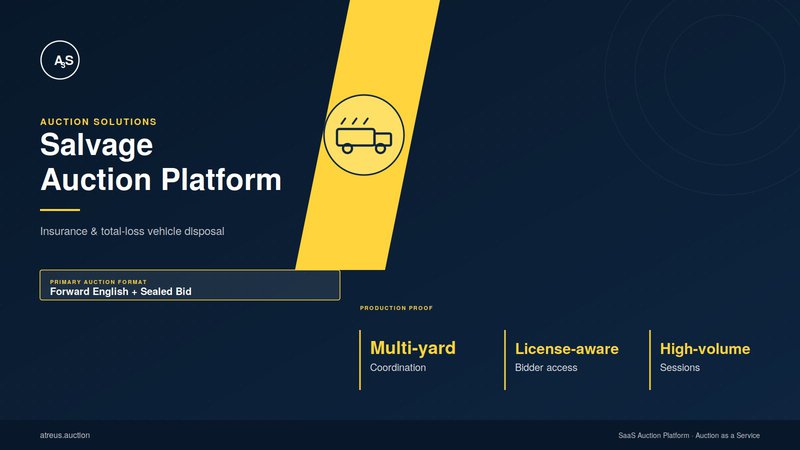
Atreus is a custom-built salvage auction platform and total-loss vehicle auction software for insurance carriers, salvage processors, dismantlers, parts auction operators, and contracted disposers running high-volume online vehicle auctions. It supports Forward English (Copart-style ascending), Sealed Bid (for bulk insurance portfolios), and Dutch (for clearance lots) on one API-first engine — the same engine that has conducted more than 51 million auctions in production deployments.
If you are evaluating salvage auction software to launch your own insurance-vehicle disposal channel, replace a legacy salvage marketplace listing, or stand up a captive salvage operation, this page explains what Atreus does, who it is built for, and how to engage the team for a custom rollout.
What is salvage auction software?
Salvage auction software is the platform a salvage operator, insurance carrier, or vehicle remarketer uses to dispose of total-loss, damaged, end-of-life, and unrepairable vehicles to dismantlers, rebuilders, parts buyers, and exporters. A complete salvage auction platform handles four things: vehicle intake (VIN, condition, salvage title, photos, run-and-drive status), bidder management (licensed dismantler verification, deposit handling, export documentation), auction execution (high-volume timed sales, often hundreds of lots per session), and post-sale logistics (title transfer, pickup scheduling, multi-yard coordination).
Atreus delivers all four components on one engine. The Copart and IAA model — high-volume online ascending auctions with rapid throughput — is the operational pattern the platform is designed for.
Quick answer: Salvage auction software runs the disposal of total-loss and damaged vehicles to licensed dismantlers, rebuilders, and parts buyers. Atreus supports Copart-style Forward English ascending auctions, Sealed Bid for bulk insurance portfolios, and multi-yard logistics on one platform.
Who Atreus salvage auction software is built for
Insurance carriers running captive salvage disposal
Insurance companies disposing of total-loss vehicles directly rather than through a third-party salvage marketplace. The captive model eliminates per-vehicle marketplace fees, retains full salvage value capture, and keeps loss-data analytics in-house.
Independent salvage processors and dismantlers
Salvage operators receiving vehicle assignments from multiple insurance carriers and running their own auction channel. The platform supports multi-source intake, separate carrier reporting, and direct dismantler bidder pools.
Total-loss processing centers and parts auction operators
Centralized total-loss centers running both whole-unit auctions and parts-out auctions on the same platform. Forward English for whole units; Dutch for time-sensitive parts clearance.
Multi-yard salvage operators
Salvage businesses operating across multiple physical yards. The platform coordinates inventory across locations, schedules pickups, and routes bidders to the correct pickup yard automatically.
Specialty salvage operators
Marine salvage, motorcycle salvage, RV salvage, heavy-truck salvage, and equipment salvage operators running specialized vertical auctions. Same auction engine, vertical-specific intake and bidder qualification.
Export-focused salvage auctions
Operators serving international rebuilder markets where bidder verification, export documentation, and currency handling differ from domestic dismantler sales.
Auction formats supported for salvage operations
Forward English auction (default for retail dismantler sales)
Open ascending — the Copart and IAA standard. The default format for high-volume timed online salvage auctions where dismantlers, rebuilders, and parts buyers compete for individual vehicles. Maximizes price discovery and produces the throughput required for high-volume operations (hundreds of lots per session).
Sealed Bid auction (for bulk insurance portfolio sales)
Each bidder submits one confidential bid for a portfolio of vehicles; the highest sealed bid wins. The default for insurance carriers selling bulk total-loss portfolios to large dismantler networks or wholesale rebuilders, where individual-vehicle pricing competition matters less than total-portfolio pricing efficiency.
Dutch auction (for clearance and aged inventory)
Descending price — useful for vehicles that have not sold through the standard ascending format and need to clear at whatever price the market will accept. Common for non-running, severely damaged, or older units.
Reverse English auction (for procurement of salvage services)
For carriers and large fleets procuring salvage-handling services from a panel of approved processors — vehicle pickup, storage, processing, and disposal as a service contract. Suppliers compete down on per-vehicle service fees.
Hybrid Dutch auction (for distressed-fleet portfolios)
A three-stage Atreus format originally built for NPL portfolio disposal in ProZorro.Sale. Applied to salvage, it fits large distressed-fleet portfolios where multi-stage price discovery (descending → sealed → best-price) extracts more value than a single-format auction.
Texas auction (for specialty single-lot salvage)
Last-bidder-standing — useful for high-value collector or specialty salvage where endurance bidding produces a premium close.
How the Atreus salvage platform works (technical view)
A typical salvage auction lifecycle:
- Vehicle intake — VIN, salvage title type, condition grade, run-and-drive status, photos (often 30+ angles per vehicle), location yard, reserve, and auction parameters pushed via API. Total-loss intake from carrier claims systems is a standard integration pattern.
- Title and documentation handling — salvage title type (junk, rebuildable, parts-only, certificate of destruction), state, and export eligibility tracked per vehicle. Bidders see filtered inventory based on their license and territory.
- Bidder qualification — dismantler license verification, deposit on file, jurisdiction-specific bidder approval. Atreus supports tiered bidder access — some bidders see all inventory; some see only specific salvage-title classes; some see only export-eligible units.
- Auction execution — Forward English rounds run on a fixed schedule (typically multiple sessions per day for high-volume operators). The engine validates every bid, enforces anti-sniping logic, and broadcasts state via WebSocket.
- Settlement and logistics — winner, winning price, pickup yard, payment instructions, and pickup window returned via API. Multi-yard operators route the bidder to the correct location automatically.
Core platform capabilities
- Public REST API for programmatic auction control and integrations with claims, AMS, and rebuilder systems.
- Multi-yard coordination for operators with inventory across multiple physical locations.
- Bidder license and deposit management built into the bidder onboarding flow.
- Salvage title type filtering so bidders see only inventory they are licensed to purchase.
- High-volume session support — hundreds of lots per session, multiple sessions per day.
- Odoo ERP integration for operators using Odoo as their financial and inventory backbone.
- AWS cloud deployment with elastic capacity for peak-volume disposal events.
- White-label UI — bidders see the operator's brand, not Atreus.
Integration with claims and salvage management systems
Common integration points include claims management systems (Guidewire ClaimCenter, Duck Creek Claims, Sapiens, custom carrier systems), salvage AMS (Audatex, CCC, Mitchell, AIMS), and dismantler-side systems (Hollander, Car-Part, eBay Motors integrations). Each integration is scoped during the custom engagement.
Why operators choose Atreus over Copart, IAA, or third-party salvage marketplaces
Salvage operators evaluating the market typically compare four options:
- List on Copart, IAA, or another third-party salvage marketplace. Fast access to a large bidder pool, but the operator pays per-vehicle fees on every sale and has no control over the bidder relationship or platform.
- Buy off-the-shelf salvage SaaS. Lower fees than the marketplaces, but most off-the-shelf platforms are designed for general remarketing, not the specific operational pattern of high-volume salvage (multi-yard, license verification, salvage-title handling).
- Build in-house. Maximum control, but a significant engineering investment for a non-core capability.
- Custom-built platform on a proven engine — the Atreus model.
For salvage operators specifically, the deciding factors are typically:
- Throughput. The engine has been stress-tested at procurement-event scale (tens of thousands of concurrent auctions). Salvage volume is well within that envelope.
- Multi-yard architecture. Salvage operators with multiple physical yards need a platform that coordinates inventory, bidder routing, and pickup logistics across locations as a first-class feature, not a workaround.
- License-aware bidder access. Salvage bidders are not interchangeable — dismantler license type, state, and export eligibility filter what each bidder can see and bid on.
- Captive deployment economics. For insurance carriers and large salvage operators, the per-vehicle fee math favors a custom platform once volume crosses a few thousand vehicles per month.
Frequently asked questions
What is the difference between salvage auction software and a salvage marketplace?
Salvage auction software is the platform an operator runs to conduct their own auctions — owning the bidder pool, the data, and the brand. A salvage marketplace (Copart, IAA, ACV Salvage, Liquidation.com Salvage) is a third-party venue where an operator lists vehicles into the marketplace's bidder pool and pays per-vehicle fees on every sale.
Can Atreus replace our current Copart or IAA listing?
Yes. Insurance carriers and salvage processors running their own platform on Atreus stop paying per-vehicle marketplace fees, own the bidder pool directly, and capture full salvage value. Migration scoping covers bidder onboarding (recruiting your existing dismantler network onto your platform), inventory and intake integration, and operational cutover.
Does Atreus support salvage title type handling (junk, rebuildable, parts-only)?
Yes. Each vehicle is tagged with its salvage title type, state, and export eligibility. Bidders see only inventory they are licensed to purchase based on their dismantler license type, jurisdiction, and any operator-defined access tiers.
Can the platform run high-volume salvage sessions (500+ lots per session)?
Yes. The engine has been stress-tested at procurement-event scale (tens of thousands of concurrent auctions). High-volume salvage sessions with hundreds of lots are well within the operational envelope. The platform runs on AWS with elastic capacity for peak-volume disposal events.
How does multi-yard coordination work?
Each vehicle is tagged with its physical yard location at intake. Bidders see inventory filtered by their accessible yards (or all yards, depending on operator configuration), and post-sale routing assigns the correct pickup yard to each winner automatically. Multi-yard operators run one platform across all locations with isolated reporting per yard if needed.
Does Atreus integrate with claims management or salvage AMS?
Yes. Common integration points include Guidewire ClaimCenter, Duck Creek Claims, Sapiens, Audatex, CCC, Mitchell, AIMS, and custom carrier systems. Integration is built during the custom engagement based on the operator's specific systems.
Can Atreus handle international export salvage auctions?
Yes. Bidder qualification supports export-eligible verification, and currency handling is configurable. Export-specific documentation workflows (bills of lading, export titles, vehicle export forms) are scoped during the custom engagement.
What is the difference between Forward English and Sealed Bid for salvage?
Forward English is open ascending — the Copart/IAA standard. Maximum price discovery, public competition between dismantlers. The default for individual-vehicle retail dismantler sales. Sealed Bid is one-shot confidential — used for bulk insurance portfolios where a carrier is selling 50, 100, or 1,000 vehicles to one wholesale buyer in a single transaction.
Does the platform handle motorcycles, RVs, boats, and heavy trucks?
Yes — vertical-specific intake and bidder qualification are configured during the custom engagement. The auction engine is the same; what differs is the metadata model (motorcycle frame numbers vs marine HIN vs heavy-truck VIN), the bidder qualification rules, and the photo/condition documentation workflow.
How is salvage value reporting and analytics handled?
The BI module produces aggregate reporting on average sale price by vehicle type, ratio of sale price to ACV, bidder participation, and yard-level performance. Reports are exportable for carrier and management use.
Can Atreus support a parts-out auction channel alongside whole-unit salvage?
Yes. Parts-out auctions typically run as Dutch (descending price for time-sensitive clearance) or Forward English depending on parts value. Both formats run on the same engine. Some operators use the parts channel for non-running or stripped vehicles where whole-unit Forward English does not produce a viable price.
How is the platform priced for salvage operations?
Pricing is set during the scoping conversation. The captive deployment economics typically favor Atreus once an operator's volume crosses a few thousand vehicles per month — at that point, marketplace per-vehicle fees exceed the cost of running a dedicated platform. Below that volume, marketplaces may still be more economical. Contact the Atreus team for a scoped comparison.
Talk to the Atreus team
Every Atreus salvage deployment is a custom engagement scoped to the operator's specific disposal model, yard footprint, claims-system integration, and bidder population. There is no self-serve sign-up.
If you are evaluating salvage auction software for an insurance carrier, salvage processor, total-loss center, multi-yard salvage operator, or specialty salvage business, the next step is a scoping conversation with the Atreus team.
Contact the Atreus team at atreus.auction to start a custom salvage auction platform engagement.