Government Auction Platform & Public Sector Procurement Software
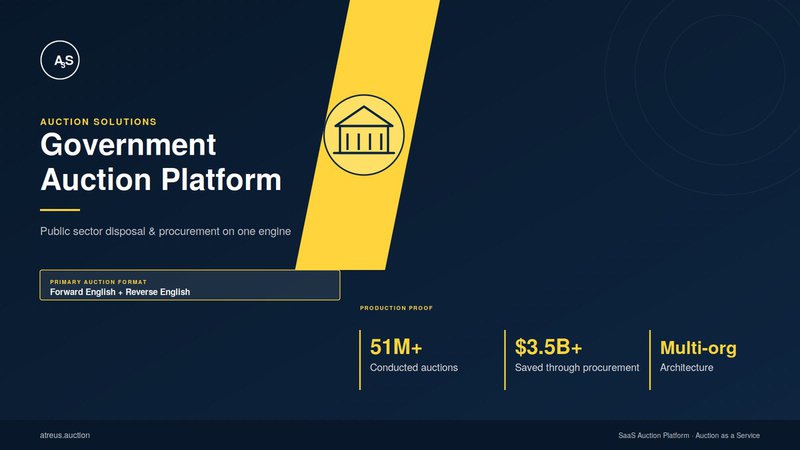
Atreus is a custom-built government auction platform and public-sector procurement software for federal, state, and municipal agencies, GSA-style disposal programs, police and impound asset disposal, and contracted public-asset operators. It supports both sides of the public-sector auction stack — Forward English for asset disposal and Reverse English for procurement and tendering — through one API-first engine, the same engine behind ProZorro at country-wide e-procurement scale.
If you are evaluating government auction software to run public surplus disposal, replace a legacy procurement system, or stand up a new digital tendering platform, this page explains what Atreus does, who it is built for, and how to engage the team for a custom rollout.
What is government auction software?
Government auction software is the platform a public-sector body uses to dispose of surplus assets and to procure goods or services through transparent, auditable, competitive bidding. Two distinct functions sit on the same platform: asset disposal (selling vehicles, equipment, real estate, seized property, and other surplus to the highest bidder) and procurement (sourcing goods and services from suppliers at the lowest qualifying price). Both must run with full audit trail, regulatory compliance, multi-organization access, and bidder verification.
Atreus delivers both functions on one engine. The same platform that runs an impound-vehicle ascending auction in the morning can run a multi-round reverse procurement tender in the afternoon, with no second system to license or maintain.
Quick answer: Government auction software is the platform public agencies use to run transparent, auditable auctions for both asset disposal (Forward English) and procurement (Reverse English). Atreus runs both formats on one engine — the same Reverse English module that has saved more than $3.5 billion across 4.11 million conducted reverse auctions on ProZorro.
Who Atreus government auction software is built for
Federal, state, and municipal asset disposal agencies
Government bodies disposing of surplus vehicles, equipment, IT hardware, office furniture, and real estate. Atreus runs the public-facing ascending auctions, manages bidder verification, and produces the audit trail required for public reporting.
Police, sheriff, and DOT impound disposal
Law-enforcement agencies and transportation departments running scheduled impound auctions. Forward English is the default format; Sealed Bid is supported for high-value seized assets where confidentiality is required during the bidding round.
GSA-style multi-agency disposal programs
Centralized disposal authorities consolidating surplus from multiple agencies. The platform supports multi-organization access — each contributing agency sees only its own assets and bidder activity, while central administrators have full visibility.
Public procurement authorities
Agencies running competitive procurement for goods, services, and works contracts. Reverse English is the default format. The same module that powers ProZorro is available for public-procurement deployments.
School districts, transit authorities, and public utilities
Quasi-government bodies running specialized disposal — surplus buses, retired transit vehicles, decommissioned utility equipment — and procurement of fleet maintenance, IT services, or specialized supplies.
Municipal real estate and tax-deed disposal
Cities and counties disposing of tax-foreclosed or municipally-owned real estate. Forward English for retail-style disposal; Sealed Bid for commercial and confidential transactions; Hybrid Dutch for distressed-property portfolios.
Auction formats supported for government use
Forward English auction (default for asset disposal)
Open ascending — the universally recognized format for public surplus, impound, and tax-foreclosure auctions. Maximum price discovery and full public transparency. The default when an agency is selling.
Reverse English auction (default for procurement)
Suppliers compete down — the lowest qualifying bid wins the supply contract. The procuring agency acts as auctioneer; pre-qualified suppliers participate as bidders. The number of rounds and round duration are machine-controlled, which is what makes the format defensible against challenges. Between 2015 and 2019, the underlying Reverse English engine running ProZorro saved more than $3.5 billion across 4.11 million conducted reverse auctions.
Sealed Bid auction (for sensitive or one-shot tenders)
Each bidder submits one confidential bid; the highest (for disposal) or lowest qualifying (for procurement) sealed bid wins. The default for one-round RFPs, sensitive seized-asset disposal, and procurement scenarios where bidder collusion risk requires hidden bidding.
Dutch auction (for surplus clearance)
Descending price — the clock starts high, drops in steps, the first bidder accepts. Useful for clearing large volumes of low-value surplus where speed matters more than maximizing each lot.
Hybrid Dutch auction (for distressed assets and complex portfolios)
A three-stage Atreus format: Dutch → Sealed Bid → Best Price. Originally built for NPL disposal within the ProZorro.Sale system, where it conducted $279 million in revenue across 47 million auctions. The right format for state-asset privatization, distressed-property portfolios, and any disposal program with complex multi-stage price discovery.
Texas auction (for property leases and specialized assets)
Last-bidder-standing — the seller announces a starting price, bidding continues until only one bidder remains willing to take the lot. Best fit for property lease auctions and specialized single-lot disposal where endurance bidding produces a premium close.
How the Atreus government platform works (technical view)
Atreus is API-first. The auction engine exposes a public REST API at https://auctions-api.atreus.auction/. The agency's existing systems — case management, asset registry, financial system, supplier database — remain the source of truth. The auction engine runs the bidding round and returns the result.
A typical government asset-disposal auction lifecycle:
- Asset intake — surplus item details, photos, condition, reserve, and auction parameters are pushed via API. With Odoo deployments, this is automated from the asset registry.
- Bidder onboarding — public bidders register through the agency's UI; verification and compliance checks run before bidding access is granted.
- Auction execution — the engine runs the timed Forward English rounds, validates every bid, logs every state change for audit, and broadcasts real-time updates over WebSocket.
- Settlement — winner, winning price, and full bid history return through the API to the agency's finance system for invoicing and asset transfer.
- Post-sale handoff — title transfer, payment processing, and pickup scheduling continue in the agency's existing systems.
A typical procurement (Reverse English) lifecycle is symmetric: the agency publishes the requirement, suppliers pre-qualify, multi-round descending bidding runs to award.
Core platform capabilities
- Public REST API for full programmatic control of every auction.
- Multi-organization architecture — multiple agencies on one platform with isolated views.
- Full audit trail — every bid, state change, and operator action logged for compliance.
- BI / analytics module — aggregate savings reporting (for procurement) and revenue reporting (for disposal).
- Odoo ERP integration for agencies running Odoo as their financial system.
- AWS cloud deployment with elastic capacity for procurement-event spikes.
- White-label UI — bidders never see "Atreus" branding; the public sees only the agency.
Why agencies choose Atreus over GovDeals, GSA Auctions, or off-the-shelf SaaS
Agencies evaluating government auction software typically compare four options:
- Use a third-party marketplace (GovDeals, GovPlanet, Public Surplus, GSA Auctions). Fast to start, but the agency pays per-vehicle/per-lot fees, has no control over the platform, and surrenders the bidder relationship to a private operator.
- Buy off-the-shelf government auction SaaS. Lower fees than marketplaces, but the platform was built around someone else's procurement code and rarely supports both disposal and procurement on one engine.
- Build in-house. Maximum control, but multi-year engineering investment and significant operational risk for a public-sector procurement team.
- Custom-built platform on a proven engine — the Atreus model.
For public-sector evaluations, the deciding factors are typically:
- Both disposal and procurement on one platform. Most competitors handle one or the other. Atreus runs Forward English (disposal) and Reverse English (procurement) on the same engine, so an agency does not need two systems.
- Audit-grade infrastructure. The engine has been operating in regulated, auditable environments at country-wide scale for over a decade.
- Multi-agency / multi-organization architecture. The platform was designed from day one for many independent organizations sharing one infrastructure — exactly the architecture central disposal and procurement authorities need.
- No per-transaction fees on the agency. Custom platforms are licensed, not metered. Agencies do not pay 5–10% of every disposed asset to a marketplace operator.
- Custom engagement, not generic SaaS. Public-sector deployments have specific compliance, accessibility, and reporting requirements that off-the-shelf SaaS rarely meets.
Frequently asked questions
What is the difference between government auction software and a public surplus marketplace?
Government auction software is the platform an agency runs to conduct its own auctions, with full control over rules, bidders, and data. A public surplus marketplace (GovDeals, Public Surplus, GovPlanet) is a third-party venue where the agency lists items to bid into the marketplace's existing buyer pool, paying per-transaction fees on every sale.
Can Atreus replace our current GovDeals / Public Surplus / GovPlanet listing?
Yes. An agency running its own Atreus platform stops paying per-transaction marketplace fees, owns the bidder pool directly, and keeps full custody of the auction data. Migration is part of the custom engagement — the Atreus team scopes which auction types are needed, how bidders are onboarded, and what audit reporting must integrate with existing agency systems.
Does Atreus support GSA-style multi-agency consolidation?
Yes. The multi-organization architecture allows many independent agencies to operate on the same platform with isolated views — each agency sees only its own assets and bidders, while a central administrator has aggregate visibility across all participating organizations. This is the same architecture that supports 50+ independent organizations on the ProZorro.Sale platform.
Is Atreus suitable for public procurement (not just asset disposal)?
Yes — public procurement is one of Atreus's strongest use cases. The Reverse English module is the same one that powers ProZorro, where it has saved more than $3.5 billion across 4.11 million conducted reverse auctions. The platform supports multi-round descending bidding, supplier pre-qualification, and full procurement-grade audit trail.
What audit and reporting capabilities does the platform provide?
Every bid, state change, and operator action is logged with timestamp and actor. The BI module provides aggregate reporting — total revenue (disposal), total savings vs. starting price (procurement), bidder participation, auction completion rates. Reports can be exported for public-records requests and scheduled disclosures.
How does Atreus handle police impound and seized-asset auctions?
Forward English is the default for impound vehicle disposal — public ascending auction with bidder verification and on-site or online inspection. For sensitive seized assets (where confidentiality is required during bidding), Sealed Bid is supported. Both formats produce the audit trail required for chain-of-custody and disposition reporting.
Can the platform handle high-volume procurement events?
Yes. The platform runs on AWS with elastic capacity. The underlying engine has handled procurement-event days with tens of thousands of concurrent reverse auctions on ProZorro.
Does the platform support accessibility (WCAG / Section 508)?
Bidder-facing UIs are built to meet accessibility standards required for public-sector deployment. Specific compliance requirements (WCAG 2.1 AA, Section 508, EU EN 301 549) are scoped during the custom engagement.
How is the platform priced for government agencies?
Pricing is set during the scoping conversation. There is no published self-serve price list — public-sector deployments vary too much by scope (single agency vs multi-agency, disposal-only vs disposal+procurement, integration depth, audit requirements) for a uniform price. Contact the Atreus team for a scoped quote.
What integrations are available for public-sector financial and asset systems?
Atreus has a direct Odoo ERP integration. For other systems used in public sector — Tyler Munis, Workday, SAP for Public Sector, Oracle PeopleSoft, Infor — integration is built during the custom engagement using the public REST API.
How long does a government deployment take?
Timing depends on integration complexity, accessibility requirements, audit-trail customization, and the number of agencies on the platform. The auction engine itself is production-ready; most of the timeline is the agency's specific UI, integrations, and compliance customization, agreed during scoping.
Can Atreus power tax-deed and tax-lien sales for cities and counties?
Yes. Forward English handles the standard tax-foreclosure ascending auction. Sealed Bid is supported for confidential commercial-property tax sales. Tax-deed and tax-lien-specific workflows (redemption periods, statutory notices, lien priority handling) are configured during the custom engagement.
Talk to the Atreus team
Every Atreus government deployment is a custom engagement scoped to the agency's specific disposal and procurement needs, integration landscape, and compliance requirements. There is no self-serve sign-up.
If you are evaluating online auction software for a public agency, GSA-style disposal program, police or DOT impound operation, public procurement authority, or municipal asset disposal program, the next step is a scoping conversation with the Atreus team.
Contact the Atreus team at atreus.auction to start a custom government auction platform engagement.