Estate Sale & Online Estate Auction Platform
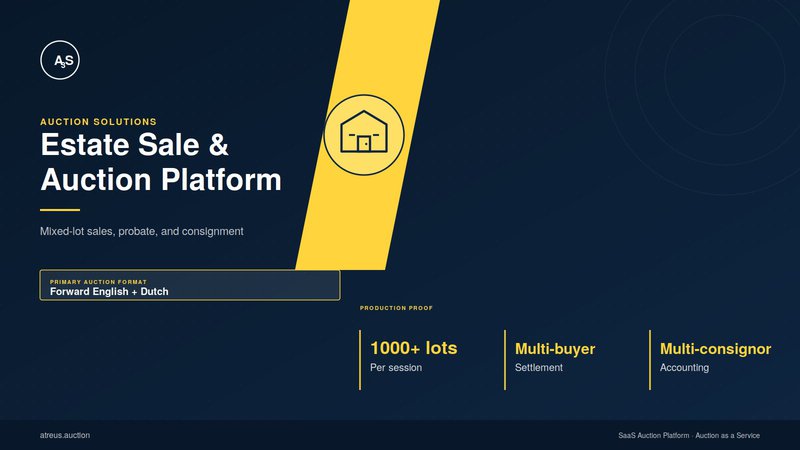
Atreus is a custom-built estate auction platform and online estate sale software for estate auctioneers, probate processors, downsizing services, and high-throughput estate sale companies. It supports Forward English (mixed-lot ascending), Dutch (clearance of remaining lots), and Sealed Bid (high-value individual items) on one API-first engine.
If you are running an estate auction business that has outgrown listing-only platforms like EstateSales.org or AuctionZip, or if you are launching a regional estate auction marketplace and want to own the platform rather than license a generic auction widget, this page explains what Atreus does, who it is built for, and how to engage the team for a custom rollout.
What is online estate auction software?
Online estate auction software is the platform an estate auctioneer uses to manage and sell mixed-lot inventory — household goods, antiques, art, collectibles, vehicles, jewelry, tools, real estate, and everything else that comes out of an estate. Estate auctions are operationally distinct from category-specialist auctions: a single sale routinely contains 200 to 2,000 individual lots covering a dozen categories, photographed and catalogued under tight time pressure, often within days of the family or estate executor signing the contract.
A complete estate auction platform handles bulk lot intake (rapid cataloguing and photography workflow), mixed-format scheduling (timed ascending for the bulk inventory; live or hybrid format for headline lots), clearance handling (Dutch auctions for lots that did not move in primary), and post-sale settlement (often hundreds of separate buyers per event, each with their own pickup and shipping arrangement).
Quick answer: Online estate auction software runs the timed sale of mixed-lot estate inventory — household goods, antiques, art, vehicles, jewelry, and collectibles. Atreus supports Forward English ascending for the bulk inventory, Dutch auctions for clearance, and Sealed Bid for individual high-value items, all on one platform.
Who Atreus estate auction software is built for
Independent estate auctioneers
Local and regional estate auctioneers running scheduled in-person and online estate sales. The platform handles the operational throughput estate businesses require — high lot count, mixed categories, fast turnaround.
Probate and trust estate processors
Companies handling probate-mandated estate liquidations under court supervision. Audit trail, transparent bidding, and reporting requirements differ from typical commercial auctions; the platform produces the documentation probate courts and trust officers expect.
Downsizing and senior-move estate services
Companies serving downsizing seniors and family estates with a turn-key liquidation service. Often combine in-person estate-sale operations with online auction for higher-value items.
Antique malls and consignment auction houses
Operators running scheduled estate-style consignment auctions where multiple consignors contribute lots to a single sale. Multi-consignor accounting is a first-class workflow.
Real estate auctioneers running estate-tied property sales
Auctioneers running estate sales that include the real estate. Real-estate-specific format (Forward English with reserve, Sealed Bid for commercial) runs on the same platform alongside the contents auction.
Online estate marketplaces
Aggregator platforms that host multiple independent estate auctioneers under one bidder-facing brand. Multi-tenant architecture supports many auctioneer accounts on one platform.
Auction formats supported for estate sales
Forward English auction (default for the bulk of inventory)
Open ascending — the default for the timed online portion of an estate sale, where dozens to hundreds of lots run simultaneously with staggered close times. Anti-sniping auto-extension on late bids prevents bid-and-disappear behavior that erodes bidder trust.
Dutch auction (for clearance of remaining lots)
Descending price — the right format for lots that did not move in the primary Forward English round. Many estate auctioneers run a small Dutch session at the end of an event to clear no-sale lots at whatever price the market accepts, rather than carrying inventory forward.
Sealed Bid auction (for individual high-value items)
Each bidder submits one confidential bid; the highest sealed bid wins. The default for individual high-value items within an estate — fine art, signature jewelry, rare collectibles — where the consignor or estate executor wants confidential pricing rather than public ascending bids.
Forward English with live-room hybrid (for major estate events)
For large estate events with an in-person live audience, online bidders participate alongside the live floor through the real-time bid feed. Common for high-profile estate dispersals where local buyers attend in person and out-of-state bidders participate online.
Texas auction (for premium single lots)
Last-bidder-standing — useful for headline single lots within an estate where endurance bidding produces a premium close.
Hybrid Dutch auction (for distressed estate portfolios)
A three-stage Atreus format originally built for NPL portfolio disposal in ProZorro.Sale. Applied to estate sales, it fits large bankruptcy-estate or distressed-estate dispersals where multi-stage price discovery extracts more value across a complex multi-category portfolio.
How the Atreus estate platform works (technical view)
A typical estate auction lifecycle:
- Bulk lot intake — fast cataloguing workflow with mobile photography, rapid description, category tagging, reserve, and auction parameters. Estate sales typically run 200–2,000 lots; intake throughput matters.
- Multi-category presentation — bidders browse and search by category, value range, lot status, and close time. Atreus delivers the data model; the operator's UI delivers the search and presentation experience.
- Bidder onboarding — public bidder registration with optional deposit handling for higher-value lots. Tiered access supports invited-only bidder pools for sealed-bid headline lots.
- Auction execution — Forward English with staggered close times runs the bulk of inventory; Sealed Bid runs in parallel for headline lots; live-room integration runs for major in-person events.
- Multi-buyer settlement — an estate event commonly produces hundreds of separate winning buyers, each with their own pickup window, shipping arrangement, and payment instruction. Settlement is per-buyer-per-lot, not per-auction.
- Multi-consignor accounting — for consignment-based estate operators, per-consignor revenue tracking, commission calculation, and settlement reporting flow through the operator's accounting system via API or Odoo integration.
Core platform capabilities
- Public REST API for bulk intake automation, lot management, and accounting integration.
- High lot-count session support — events with 1,000+ lots running simultaneous staggered closes are well within the operational envelope.
- Multi-category search and filtering — bidders find inventory across diverse categories quickly.
- Anti-sniping auto-extension for timed online auctions.
- Multi-buyer settlement workflow with per-lot pickup and shipping coordination.
- Multi-consignor accounting with per-consignor commission and revenue reporting.
- Odoo ERP integration for operators using Odoo for inventory and accounting.
- White-label UI — every visible surface is the auctioneer's brand.
Why operators choose Atreus over EstateSales.org, AuctionZip, or off-the-shelf SaaS
Estate auction operators evaluating the market typically compare four options:
- List on a third-party estate marketplace (EstateSales.org, AuctionZip, EstateSale.com, Live Auctioneers, Invaluable). Fast access to a regional or national estate-buyer audience, but the operator pays per-sale or listing fees and has no control over the bidder relationship or platform.
- Buy off-the-shelf auction SaaS designed for general remarketing or single-category auctions. Lower fees, but rarely supports the high lot count, multi-category presentation, and multi-buyer settlement complexity an estate auctioneer actually runs.
- Build in-house. Maximum control, but a substantial engineering investment for a non-core capability.
- Custom-built platform on a proven engine — the Atreus model.
For estate operators specifically, the deciding factors are typically:
- High lot-count throughput. The auction engine has been stress-tested at procurement-event scale (tens of thousands of concurrent auctions). 1,000-lot estate events sit well within the operational envelope.
- Multi-buyer settlement complexity. Estate events produce hundreds of separate winning buyers, each with individual pickup, shipping, and payment workflows. The platform handles this complexity natively.
- Multi-consignor accounting. For consignment-based estate operators, per-consignor revenue tracking is a first-class workflow, not an export-and-spreadsheet workaround.
- Bidder relationship ownership. Estate buyers are repeat buyers — they attend many sales by the same auctioneer. Owning the bidder pool directly compounds in value over time.
Frequently asked questions
What is the difference between estate auction software and a marketplace like EstateSales.org?
Estate auction software is the platform an auctioneer runs to conduct their own auctions, owning the bidder pool, the data, and the brand. A marketplace (EstateSales.org, AuctionZip, EstateSale.com, Invaluable, Live Auctioneers) is a third-party venue where the auctioneer lists sales into the marketplace's existing audience and pays listing or per-sale fees. With software, the auctioneer owns the buyer relationship long-term.
Can Atreus handle 1,000+ lots in a single sale?
Yes. The auction engine has been stress-tested at procurement-event scale (tens of thousands of concurrent auctions). 1,000-lot estate events with staggered close times are well within the operational envelope. The platform runs on AWS with elastic capacity for high-volume events.
How does multi-buyer settlement work?
An estate event commonly produces hundreds of separate winning buyers, each potentially winning multiple lots. Settlement is per-buyer-per-event — a buyer who wins 12 lots receives one consolidated invoice covering all 12, with one payment workflow and one pickup or shipping coordination. The platform handles this consolidation natively rather than treating each lot as a standalone transaction.
Does Atreus support multi-consignor estate auctions?
Yes. For consignment-based estate operators, per-consignor revenue tracking, commission calculation, and settlement reporting are first-class workflows. Each consignor sees their own lot performance and settlement; the operator's accounting reflects per-consignor net proceeds.
Can I run a hybrid in-person + online estate event?
Yes. For major estate events with an in-person live audience, online bidders participate alongside the live floor through the real-time bid feed. Auctioneer-side controls manage the live floor; online bids enter the same bid queue. This is the standard configuration for high-profile estate dispersals.
How does Atreus handle Dutch auctions for unsold lots?
Dutch (descending-price) auctions are supported as a first-class format. A common pattern: at the end of a primary Forward English estate event, the auctioneer runs a small Dutch session for lots that did not meet reserve. The clock starts at a manageable price and drops in steps until a bidder accepts. This clears inventory rather than carrying no-sale lots into the next event.
Does the platform support real estate auctions tied to estate sales?
Yes. Real-estate-specific format (Forward English with reserve, Sealed Bid for confidential commercial transactions) runs on the same platform alongside the contents auction. An estate sale that includes the house can be run as a single multi-format event.
What integrations are available for estate auctioneers?
Common integration points include payment processors with multi-buyer support, shipping coordination services for post-sale fulfillment, Odoo for inventory and accounting, and (for probate-tied operators) court-reporting export formats. Each integration is scoped during the custom engagement.
Can Atreus power probate and trust estate liquidations?
Yes. Probate-tied auctions require additional documentation, transparent bidding records, and reporting formats acceptable to probate courts and trust officers. The platform's full audit trail (every bid, every state change, timestamped and exportable) produces the documentation typically required.
How is buyer's premium handled in estate auctions?
Buyer's premium calculation is built into settlement. Estate operators typically run a flat buyer's premium across all lots; tiered structures (one rate up to $X, another above) are supported. Premium configuration is set during scoping and adjustable per-event.
Does Atreus integrate with QuickBooks, Xero, or other small-business accounting?
Atreus has a direct Odoo ERP integration. For QuickBooks, Xero, and other small-business accounting platforms, integration is built during the custom engagement using the public REST API. Common pattern: end-of-event settlement and per-consignor commission flows export to accounting via scheduled API sync.
Is there a self-serve sign-up for small estate auctioneers?
No. Atreus is a custom engagement, not a self-serve product. For very small operators (one or two estate events per month), a third-party marketplace is typically more economical. The custom-platform model becomes economical for established estate auctioneers running consistent volume with a defined repeat-buyer community.
Talk to the Atreus team
Every Atreus estate auction deployment is a custom engagement scoped to the auctioneer's specific event model, lot-count throughput, consignor structure, and integration landscape. There is no self-serve sign-up.
If you are evaluating online estate auction software for an independent estate auctioneer, probate or trust liquidation business, downsizing service, antique mall or consignment operation, or online estate marketplace, the next step is a scoping conversation with the Atreus team.
Contact the Atreus team at atreus.auction to start a custom estate auction platform engagement.