Construction Bidding Software for General Contractors
Atreus is a custom-built construction bidding software and subcontractor procurement platform for general contractors, project owners, public works agencies, and design-build firms running competitive bidding rounds with subcontractors and material suppliers. It supports Reverse English (the default for competitive sub bidding), Sealed Bid (for one-shot RFPs), and Hybrid Dutch (for large multi-stage public works tenders) on one API-first engine — the same engine that powers ProZorro at country-wide e-procurement scale.
If you are evaluating construction bidding software to replace BuildingConnected, iSqFt, or a manual spreadsheet-and-email process, this page explains what Atreus does, who it is built for, and how to engage the team for a custom rollout.
What is construction bidding software?
Construction bidding software is the platform a general contractor or project owner uses to invite subcontractors to bid on a project, manage the bid intake, level competing proposals, and award the contract. The category covers two distinct workflows: bid management (the GC sends RFPs to subs, collects responses, levels them, and awards) and bid submission (the sub responds to GC invites with priced proposals). Most established platforms focus on one side; the operator running an active project needs both.
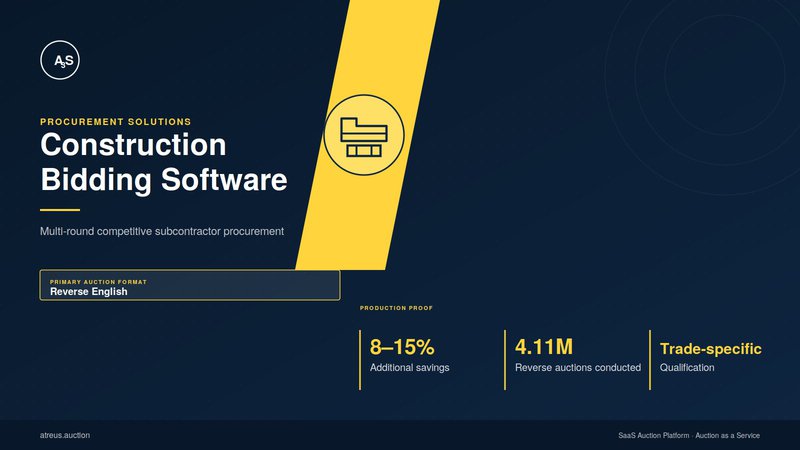
The fundamental auction question is what kind of bidding round the GC wants to run. Most software platforms in the construction category default to single-round sealed-envelope bidding — every sub submits one proposal, the GC selects. This is Sealed Bid auction terminology. The competitive alternative — Reverse English — runs multiple rounds where pre-qualified subs see anonymized competitor pricing and progressively lower their bids. Reverse English typically produces 8–15% additional savings vs single-round sealed-envelope on directly comparable scopes; this is the format Atreus is built around.
Quick answer: Construction bidding software runs the procurement process where general contractors invite subcontractors to bid competitively on project scopes. Atreus uses Reverse English as the default format — multi-round descending price competition — which has saved more than $3.5 billion across 4.11 million conducted reverse auctions on ProZorro.
Who Atreus construction bidding software is built for
General contractors managing subcontractor procurement
GCs running multiple active projects with recurring subcontractor procurement across trades (electrical, plumbing, HVAC, mechanical, concrete, drywall, painting, flooring, masonry, demolition, sitework). The platform supports trade-specific bidder pools, scope-locked bidding rounds, and award workflows.
Project owners running direct procurement
Owners (developers, REITs, institutional builders) running direct procurement for trades and materials rather than going through a GC. The Reverse English format produces measurable savings vs single-round sealed-envelope procurement.
Public works agencies running competitive tendering
Federal, state, and municipal agencies running competitive bidding for public construction projects. Sealed Bid handles single-shot statutory tenders; Hybrid Dutch fits large multi-stage public works tenders where complex price discovery is appropriate.
Design-build firms running integrated procurement
Design-build operators who own both design and construction-management functions, running coordinated procurement across long project pipelines. Multi-project bidder pools and recurring-trade procurement are common patterns.
Specialty contractors running sub-trade procurement
Specialty contractors who self-perform a primary trade but procure adjacent trades from subs. Same Reverse English workflow scaled to a smaller trade scope.
Real estate developers running multi-project procurement
Developers running multi-property pipelines who can leverage volume across projects to attract better subcontractor pricing. Multi-project bidder qualification and master-services-agreement workflows are first-class.
Auction formats supported for construction procurement
Reverse English auction (default for competitive sub bidding)
Suppliers compete down — the lowest qualifying bid wins. The GC publishes the scope, pre-qualified subs participate, multiple rounds run with each sub seeing anonymized competitor activity and progressively lowering their bid. The number and duration of rounds are machine-controlled, which is what makes the format defensible and produces consistent additional savings vs single-round sealed-envelope.
This is Atreus's foundational format. Between 2015 and 2019, the underlying Reverse English engine running ProZorro saved more than $3.5 billion across 4.11 million conducted reverse auctions — a real-world track record at country-wide e-procurement scale.
Sealed Bid auction (for single-shot RFPs and statutory tenders)
Each bidder submits one confidential bid by a deadline; the lowest qualifying bid wins. The default for one-shot RFPs, statutory public tenders that require single-round sealed-envelope procurement, and any procurement scenario where multi-round bidding is not legally permissible.
Hybrid Dutch auction (for large multi-stage public works tenders)
A three-stage Atreus format: Dutch → Sealed Bid → Best Price. Originally built for NPL portfolio disposal in ProZorro.Sale. Applied to construction, it fits large public works tenders where complex multi-stage price discovery is appropriate — typically major infrastructure, design-build mega-projects, and PPP procurement.
Forward English auction (for surplus equipment and material disposal)
Open ascending — useful for the disposal side of construction operations: surplus equipment, end-of-project material salvage, decommissioned tools and machinery.
Dutch auction (for time-sensitive material clearance)
Descending price — useful for time-sensitive material clearance on completed projects (excess concrete, steel, equipment) where speed of clearance matters more than price maximization.
How the Atreus construction bidding platform works (technical view)
A typical construction bidding lifecycle:
- Project and scope setup — project details, drawings, specifications, scope packages, and bidding parameters configured per project. Multi-project pipelines maintain shared bidder pools across projects.
- Subcontractor pre-qualification — subs register, provide insurance certificates, license verification, financial qualification, prior project references, and trade-specific qualifications. Tiered qualification supports public-pool, project-specific-invited, and master-services-agreement bidder tiers.
- Bid invitation — the GC invites pre-qualified subs to bid on specific scope packages. Invitations track open-rate, response-rate, and decline-with-reason analytics for ongoing sub-management.
- Bidding round execution — Reverse English runs the competitive multi-round descending bidding. Each sub sees their own bid history and anonymized competitor pricing (e.g., "current low bid is $X, you are 3rd of 7 active bidders"). Round duration and step rules are operator-configured.
- Bid leveling and award — the platform produces a leveled bid comparison across competing subs (line-item pricing, scope inclusions, exclusions, qualifications) for the GC's award decision. Award triggers contract generation and post-award workflow.
- Post-award integration — winner, awarded scope, awarded price, and contract data flow to the GC's project management or ERP system via API.
Core platform capabilities
- Public REST API for project setup, bidder management, scope distribution, and award integration.
- Multi-trade bidder pools with trade-specific qualification rules.
- Multi-round Reverse English with anonymized competitor visibility.
- Pre-qualification workflow with insurance, license, and financial verification.
- Bid leveling tools with line-item comparison and scope reconciliation.
- Multi-project pipeline support — recurring sub procurement across projects.
- Master-services-agreement workflow for long-term recurring trade procurement.
- Odoo ERP integration for operators using Odoo for project accounting.
- White-label UI — every visible surface is the GC's brand.
Integration with construction PM and ERP systems
Common integration points include Procore, Autodesk Construction Cloud (formerly BuildingConnected, PlanGrid), Sage Intacct Construction, Viewpoint Vista, CMiC, and Odoo. Each integration is scoped during the custom engagement.
Why operators choose Atreus over BuildingConnected, iSqFt, or off-the-shelf SaaS
GCs and owners evaluating the market typically compare four options:
- Use a third-party construction bidding marketplace (BuildingConnected by Autodesk, iSqFt by ConstructConnect, BidClerk, SmartBid, BidExpress). Fast access to a national subcontractor pool, but the platforms operate primarily as bid-distribution networks with single-round sealed-envelope as the default — not multi-round Reverse English.
- Buy off-the-shelf bid management SaaS. Lower fees, but most off-the-shelf platforms support only Sealed Bid and lack the Reverse English engine that produces the competitive savings.
- Build in-house. Maximum control, but a substantial engineering investment for a function that is not core to construction.
- Custom-built platform on a proven engine — the Atreus model.
For construction-procurement operators specifically, the deciding factors are typically:
- True Reverse English support, not just Sealed Bid. Most "bidding" software in the construction category is actually bid-management software using Sealed Bid as the format. Atreus runs true Reverse English multi-round descending bidding, which is the format that produces consistent additional savings vs single-round procurement.
- Production-scale procurement engine. The engine has saved more than $3.5 billion across 4.11 million conducted reverse auctions. The format works at scale; the engineering risk is removed.
- Multi-format on one platform. GCs and public agencies typically need both Reverse English (for competitive trade procurement) and Sealed Bid (for statutory single-round tenders). Atreus runs both on the same platform.
- Custom engagement. Construction procurement workflows are not generic. Trade-specific qualification rules, jurisdiction-specific compliance, integration with the GC's project management system — all are scoped during the custom engagement, not bolted onto generic SaaS.
Frequently asked questions
What is the difference between construction bidding software and a bid management network?
Construction bidding software is the platform a GC or owner runs to conduct their own competitive bidding rounds, owning the bidder pool, the rules, and the data. A bid-management network (BuildingConnected, iSqFt, BidClerk) is a third-party distribution network that pushes RFPs to a national subcontractor pool, typically running single-round sealed-envelope bidding by default. With software, the operator owns the long-term subcontractor relationship and runs whatever auction format produces the best procurement outcome.
How is Reverse English different from sending out an RFP?
A traditional RFP is a single-round Sealed Bid — every sub submits one proposal, the GC selects from those submitted. Reverse English is a multi-round live auction — pre-qualified subs see anonymized competitor activity in real-time and progressively lower their bids over multiple machine-controlled rounds. Reverse English typically produces 8–15% additional savings vs single-round sealed-envelope on directly comparable scopes. This is the savings ratio that drove ProZorro's $3.5 billion total across 4.11 million conducted reverse auctions.
Can Atreus replace BuildingConnected, iSqFt, BidClerk, or SmartBid?
Yes. GCs and owners running their own platform on Atreus stop paying network fees, own their subcontractor pool directly, and run the auction format that produces the best procurement outcome — typically Reverse English for competitive trade procurement, Sealed Bid for statutory single-round tenders.
Does Atreus support pre-qualification for subcontractors?
Yes. Pre-qualification workflow includes insurance certificate intake and verification, license verification, financial qualification (bonding capacity, audited financials where required), prior project references, and trade-specific qualifications. Tiered qualification supports public-pool, project-specific-invited, and master-services-agreement bidder tiers.
How does Atreus integrate with Procore, Autodesk Construction Cloud, or Sage Intacct?
Common integration points include Procore (project data, contracts, vendors), Autodesk Construction Cloud (drawings, specs, project setup), Sage Intacct Construction (accounting, AP, project costing), Viewpoint Vista, CMiC, and Odoo. Integration is built during the custom engagement using the public REST API based on the operator's specific PM and ERP stack.
Can the platform handle public works statutory tenders?
Yes. Sealed Bid handles single-round statutory tenders that require sealed-envelope procurement. Hybrid Dutch fits large multi-stage public works where complex price discovery is appropriate. Specific statutory compliance (FAR, state public-works rules, jurisdiction-specific requirements) is scoped during the custom engagement.
How are bid leveling and award decisions handled?
The platform produces a leveled bid comparison across competing subs — line-item pricing, scope inclusions, exclusions, qualifications, alternates, value-engineering proposals — for the GC's award decision. Award triggers contract generation and post-award workflow integration with the operator's PM or ERP system.
Does Atreus support master-services-agreement (MSA) procurement?
Yes. For GCs and developers running multi-project pipelines, master-services-agreement procurement (where one sub agreement covers multiple projects over a defined period) is a first-class workflow. The Reverse English round runs once for the MSA scope; project-specific work orders flow against the master agreement.
Can Atreus run Hybrid Dutch for major infrastructure tenders?
Yes. The Hybrid Dutch module was originally built for NPL portfolio disposal in ProZorro.Sale and conducted $279M in revenue. Applied to large infrastructure tenders, the three-stage format (Dutch → Sealed Bid → Best Price) extracts more value across complex multi-bidder mega-project procurement than any single-format auction.
What audit and reporting capabilities are available for procurement?
Every bid, state change, and operator action is logged. The BI module produces aggregate reporting on procurement savings (vs starting price, vs estimate, vs prior award), bidder participation rates, decline reasons, and trade-level performance. Reports are exportable for procurement-team review and (for public-sector operators) public-records compliance.
How is the platform priced for GCs and owners?
Pricing is set during the scoping conversation. Deployment economics typically favor the custom-platform model for GCs running multi-trade procurement at consistent volume across multiple projects — at that scale, network per-RFP fees and lost competitive savings vs Reverse English exceed the cost of a dedicated platform. Contact the Atreus team for a scoped comparison.
Is there a self-serve sign-up for small GCs?
No. Atreus is a custom engagement, not a self-serve product. For small GCs running occasional procurement, BuildingConnected or iSqFt are typically more economical. The custom-platform model becomes economical for established GCs and owners running consistent multi-trade procurement with a defined subcontractor community.
Talk to the Atreus team
Every Atreus construction bidding deployment is a custom engagement scoped to the operator's specific procurement model, trade mix, integration landscape, and compliance requirements. There is no self-serve sign-up.
If you are evaluating construction bidding software for a general contractor, project owner, public works agency, design-build firm, or specialty contractor running sub-trade procurement, the next step is a scoping conversation with the Atreus team.
Contact the Atreus team at atreus.auction to start a custom construction bidding software engagement.