Classic & Collector Car Auction Platform
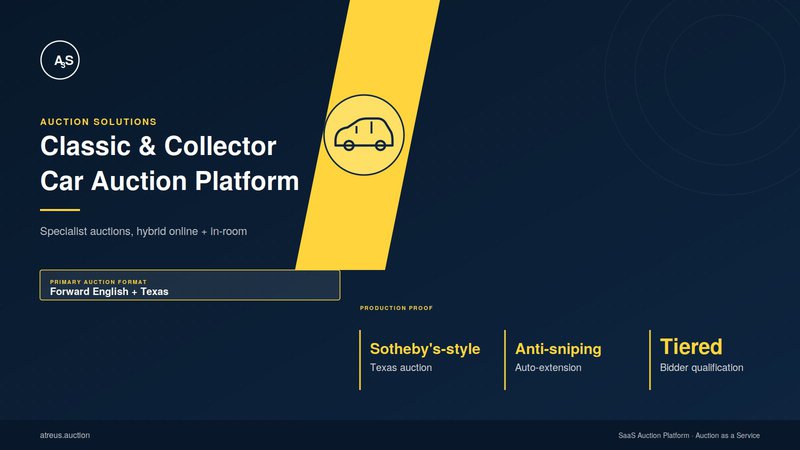
Atreus is a custom-built classic car auction platform and online collector car auction software for specialist auction houses, classic-car dealers, online enthusiast platforms, and concours-grade event operators. It supports Forward English (Barrett-Jackson and Mecum-style ascending), Texas (Sotheby's-style last-bidder-standing for headline lots), and Sealed Bid (for private collector sales) on one API-first engine.
If you are launching a collector car auction marketplace, modernizing a heritage auction house, or operating an online enthusiast platform that wants to own its bidding infrastructure rather than license a generic auction widget, this page explains what Atreus does, who it is built for, and how to engage the team for a custom rollout.
What is classic car auction software?
Classic car auction software is the platform a specialist auction operator uses to run timed online and live-broadcast collector vehicle auctions, with the workflow and presentation standards of a premium auction house. The classic-car category demands more than a generic auto auction engine — bidders expect detailed condition reports, provenance documentation, high-quality photography (often 100+ images per lot), live-streamed bidding for headline lots, and reserve-price handling that matches the discretion auction houses are accustomed to.
Atreus delivers the auction engine and integrations; the operator owns the editorial, presentation, and curatorial layer that defines the brand.
Quick answer: Classic car auction software runs the timed online and live bidding for collector and classic vehicles, with the presentation standards of premium auction houses. Atreus supports Barrett-Jackson-style Forward English ascending, Sotheby's-style Texas auctions for headline lots, and Sealed Bid for private collector sales on one platform.
Who Atreus classic car auction software is built for
Specialist classic and collector auction houses
Auction houses running scheduled live and online events for pre-war classics, post-war sports cars, modern supercars, and racing pedigree vehicles. The platform handles both online-only timed auctions and live-event bidding with online participation.
Online enthusiast auction platforms
Bring-a-Trailer-style and Cars-and-Bids-style enthusiast platforms running curated weekly or daily auctions with detailed editorial presentation. Atreus provides the auction engine; the operator's UI delivers the editorial and community experience.
Classic car dealers running online auction channels
Established dealers diversifying into auction sales for inventory that benefits from price discovery rather than fixed pricing — particularly rare, low-mileage, or matching-numbers vehicles where the right buyer determines the right price.
Concours and event-tied auction operators
Auction operators running high-profile sales at concours events, vintage racing weekends, and major automotive gatherings. The platform supports both the live-event format and the online preview/online-only auction formats that bracket major events.
Auction houses expanding into adjacent categories
Operators currently selling classic cars who want to add adjacent categories on the same platform — vintage motorcycles, classic boats, automobilia, racing memorabilia, and specialty parts — without licensing a second auction system.
Auction formats supported for classic and collector vehicles
Forward English auction (default for online and live ascending)
Open ascending — the universally recognized auction-house format. The default for both online-only timed auctions and live-event bidding. Anti-sniping logic (auto-extension on late bids) prevents the format issue that erodes trust in poorly-engineered timed auctions.
Texas auction (Sotheby's-style for headline lots)
Last-bidder-standing — the seller announces a starting price, bidding continues until only one bidder remains willing to take the lot. The Atreus brochure describes Texas as well-suited for premium single-lot sales — the "Sotheby's auction" pattern. The right format for headline collector lots where endurance bidding produces a premium close beyond what conventional ascending typically extracts.
Sealed Bid auction (for private collector sales and pre-auction offers)
Each bidder submits one confidential bid; the highest sealed bid wins. The default for private treaty sales, pre-auction collector offers, and any transaction where bidder identity must remain confidential. Common pattern: a major lot is offered first to a sealed-bid round of qualified collectors; if no acceptable bid arrives, the lot moves to public Forward English.
Reverse English auction (for procurement of restoration and storage services)
For auction houses sourcing services from a panel of approved restorers, transporters, and climate-controlled storage facilities — restoration-side suppliers compete down on per-vehicle pricing for ongoing service contracts.
Dutch auction (for clearance of unsold lots)
Descending price — useful for clearing post-event inventory that did not meet reserve in the primary auction. Some operators run a small Dutch round at the end of major events to clear no-sale lots at whatever price the market accepts.
Hybrid Dutch auction (for distressed estate and bulk collection sales)
A three-stage Atreus format originally built for NPL portfolio disposal in ProZorro.Sale. Applied to collector cars, it fits estate-of-collector dispersals where multi-stage price discovery (descending → sealed → best-price) extracts more value across a large mixed-collection sale than a single-format auction.
How the Atreus classic car platform works (technical view)
A typical classic-car auction lifecycle:
- Lot intake and curation — VIN, history, provenance documents, condition report, photography, video, expected value range, reserve, and auction parameters configured per lot. Editorial and presentation are built in the operator's UI on top of the platform's data model.
- Bidder qualification — collector-grade bidders typically require deposit, financial verification, and (for headline lots) collector references. Atreus supports tiered bidder access — public ascending bidders, qualified bidders for higher-value lots, and headline-lot bidders for sealed-bid pre-rounds.
- Auction execution — Forward English for the bulk of inventory, Texas for headline lots, Sealed Bid for any private-treaty offerings. All three formats run on the same engine, scheduled in the same event.
- Live-event integration — for in-room live auctions, online bidders participate in real-time alongside the live floor through the WebSocket bid feed. Auctioneer-side controls manage the live floor; online bids appear in the same bid queue.
- Settlement and post-sale — winner, hammer price, buyer's premium calculation, and payment instructions returned via API. Post-sale paperwork (title, transport coordination, escrow if applicable) flows through the operator's existing workflow.
Core platform capabilities
- Public REST API for full programmatic control of every auction.
- Multi-format scheduling — Forward English, Texas, Sealed Bid running on the same event calendar.
- Tiered bidder qualification — public, qualified, and invitation-only bidder pools.
- Anti-sniping auto-extension — late bids extend the close, preserving the integrity of timed auctions.
- Live-event integration — WebSocket-based real-time bid feed for hybrid online + in-room auctions.
- High-volume photography support — lots with 100+ images and video are normal in this category.
- Odoo ERP integration for operators using Odoo for inventory and accounting.
- White-label UI — every visible surface is the auction-house brand.
Why operators choose Atreus over Bring-a-Trailer, Mecum, or auction-widget SaaS
Specialist operators evaluating the market typically compare four options:
- List on a third-party enthusiast marketplace (Bring a Trailer, Cars & Bids, RM Sotheby's online channel, Hagerty Marketplace). Fast access to existing audience, but the operator pays per-vehicle fees, has no control over presentation or rules, and surrenders the bidder relationship.
- Buy off-the-shelf auction-widget SaaS. Lower fees, but most off-the-shelf widgets do not support Texas auctions, anti-sniping, qualified-bidder tiers, or the editorial presentation depth collector buyers expect.
- Build in-house. Maximum control, but a substantial engineering investment for a non-core capability for an auction house.
- Custom-built platform on a proven engine — the Atreus model.
For specialist classic-car operators, the deciding factors are typically:
- Texas auction support. Few competitors offer the Sotheby's-style last-bidder-standing format that produces premium closes on headline lots. Atreus has it as a first-class format.
- Multi-format scheduling. Specialist auctions are not single-format events. Atreus runs Forward English, Texas, and Sealed Bid on the same platform and same event calendar.
- Curatorial UI control. The auction house's brand, photography style, editorial voice, and presentation standards live in the operator's UI. Atreus delivers the auction engine; the brand experience is the operator's.
- Production-scale engine. The auction engine has conducted more than 51 million auctions in production. A specialist auction house running 50 lots per event will not stress the infrastructure — the engineering risk is removed from the equation.
Frequently asked questions
What is the difference between classic car auction software and a marketplace like Bring a Trailer?
Classic car auction software is the platform an operator runs to conduct their own branded auctions, owning the bidder pool, presentation, and rules. A marketplace (Bring a Trailer, Cars & Bids, Hagerty Marketplace) is a third-party venue where consignors list vehicles into the marketplace's existing audience and pay per-sale fees. With software, the auction house owns the relationship with collectors. With a marketplace, the marketplace does.
Does Atreus support Sotheby's-style auctions for headline collector lots?
Yes. The Texas auction format is a first-class supported format — last-bidder-standing, where the seller announces a starting price and bidding continues until only one bidder remains willing to take the lot. This is the format the Atreus brochure describes as suited to premium single-lot sales, and it is the right format for headline collector vehicles where endurance bidding produces a premium close.
Can Atreus run hybrid online + live-room auctions?
Yes. For in-room live events, online bidders participate in real-time through the WebSocket bid feed alongside the live floor. Auctioneer-side controls manage the live audience; online bids enter the same queue. This is the standard configuration for auction houses running marquee live events with simultaneous online bidding.
Does the platform handle anti-sniping for online timed auctions?
Yes. Auto-extension on late bids is a built-in anti-sniping mechanism — when a bid is placed in the final minute (or any operator-configured window), the close extends. This preserves the integrity of timed online auctions and prevents the bid-and-disappear pattern that erodes bidder trust on poorly-engineered platforms.
Can I run tiered bidder qualification (public, qualified, invitation-only)?
Yes. Atreus supports tiered bidder access — public ascending bidders, qualified bidders requiring deposit and verification for higher-value lots, and invitation-only bidders for sealed-bid pre-rounds on headline lots. Tier rules are configured during the custom engagement.
How is buyer's premium calculated and applied?
Buyer's premium calculation is built into settlement. Tiered premium structures (one rate for the first $X, another rate above that), category-specific premiums, and seller-specific premium agreements are all supported and configured during scoping.
Does Atreus support adjacent categories — vintage motorcycles, classic boats, automobilia?
Yes. Specialist operators commonly run adjacent categories on the same platform. The auction engine is identical; vertical-specific intake and bidder qualification are configured per category. An auction house running classic cars can add motorcycles, boats, and automobilia without licensing a second platform.
How does pre-auction sealed-bid offering work for headline lots?
A common pattern: a headline lot is offered first to a Sealed Bid round of qualified collectors. Each invited collector submits one confidential bid by a deadline. If the highest sealed bid meets the reserve, the lot transacts privately. If no sealed bid meets reserve, the lot moves to the public Forward English event.
What integrations are available for collector car operators?
Common integration points include inventory systems (Hagerty Insurance Marketplace, AutoMobilia, custom DMS), payment processors with collector-grade limits, transport coordination platforms (Reliable Carriers, Passport Auto Transport), and escrow services (Escrow.com for high-value transactions). Each integration is scoped during the custom engagement.
Can Atreus support concours-tied auction events?
Yes. Concours and event-tied auction operators commonly run a multi-day event structure — preview week (online listings open), live event day (Forward English live-room auctions for headline lots), online aftermath (Forward English timed auctions for non-headline inventory). All three phases run on the same Atreus platform with one bidder pool.
How is the platform priced for specialist auction houses?
Pricing is set during the scoping conversation. Specialist operators typically run lower volume than mass-market auto auctions but higher per-vehicle value, which changes the deployment economics. Contact the Atreus team for a scoped comparison against current marketplace fees or in-house build estimates.
Is there a self-serve sign-up for small classic-car operators?
No. Atreus is a custom engagement, not a self-serve product. For very small operators (a few vehicles per month), a third-party marketplace is typically more economical. The custom-platform model becomes economical for established operators with consistent volume and a defined bidder community.
Talk to the Atreus team
Every Atreus classic-car deployment is a custom engagement scoped to the auction house's specific event model, presentation standards, bidder community, and integration landscape. There is no self-serve sign-up.
If you are evaluating online auction software for a specialist classic and collector car auction house, online enthusiast platform, classic-car dealer adding an auction channel, or concours-tied event operator, the next step is a scoping conversation with the Atreus team.
Contact the Atreus team at atreus.auction to start a custom classic car auction platform engagement.