Car Auction Platform & Online Auto Auction Software
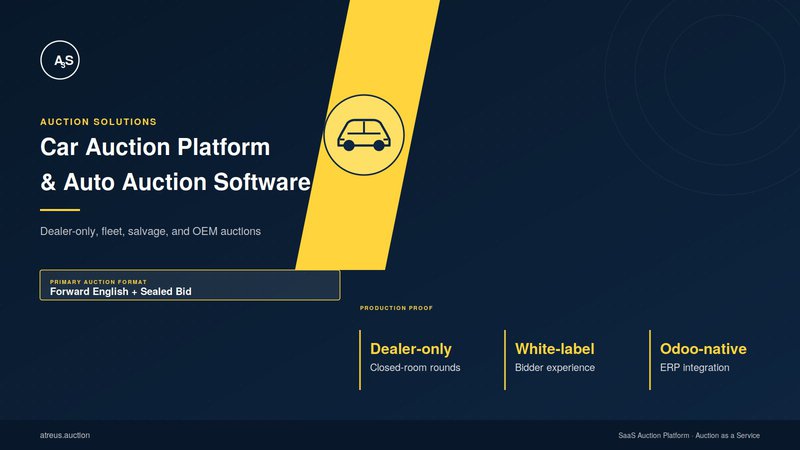
Atreus is a custom-built car auction platform and online auto auction software for dealer groups, fleet remarketers, salvage operators, government surplus disposers, and independent auction houses. It supports six auction formats — Forward English, Reverse English, Sealed Bid, Dutch, Hybrid Dutch, and Texas — through one API-first engine, the same engine that powers ProZorro and ProZorro.Sale.
If you are evaluating auto auction software to launch your own dealer-only marketplace, run online vehicle remarketing for a fleet, or replace an aging in-house bidding system, this page explains what the platform does, who it is built for, and how to engage the Atreus team for a custom rollout.
What is online car auction software?
Online car auction software is a system that lets an operator (a dealer group, auction house, fleet, or government agency) list vehicles, register and verify bidders, run timed bidding rounds, settle the sale, and integrate the result with downstream ERP, DMS, CRM, and accounting systems. A complete car auction platform handles three things at once: the auction engine (timing, bid validation, anti-sniping logic), the operator workflow (consignment, lot data, photos, condition reports, fees), and the bidder experience (web, mobile, KYC, deposits, post-sale paperwork).
Atreus delivers all three components as a single platform, with a public REST API so the operator's existing systems remain the source of truth.
Quick answer: A car auction platform is the software layer that runs an online vehicle auction end-to-end — listing, bidding, settlement, and integrations. Atreus provides this as a custom build on top of an engine that has conducted more than 47 million auctions in production.
Who Atreus auto auction software is built for
Atreus is not a self-serve SaaS sign-up. It is a custom engagement built around the operator's specific business model. The platform is designed for organizations that need to run online vehicle auctions at scale and want to own the platform, not rent one:
Auto dealer groups running dealer-only auctions
Multi-rooftop dealer groups that need a closed wholesale channel for trade-ins, off-lease vehicles, and aged inventory between locations — without paying per-vehicle fees to a third-party marketplace.
Fleet operators and lease return processors
Corporate fleets, rental companies, and lease portfolios that remarket thousands of units per month and need predictable timing, reserve handling, and direct API integration with their fleet management system.
Salvage and total-loss vehicle operators
Insurance carriers and salvage processors that need to run high-volume Copart-style or IAA-style ascending auctions with rapid title transfer, condition-report intake, and multi-yard logistics.
Government and police impound disposal
Agencies and contracted disposers running public surplus and impound vehicle auctions, where transparency, audit trail, and procurement-grade compliance are mandatory. Atreus's Reverse English module is the same code lineage that powers Ukraine's national e-procurement system.
Classic and collector car auction houses
Specialist auction houses running Barrett-Jackson- or Mecum-style live ascending sales that need a hybrid online + in-room bidding floor with a premium bidder experience.
OEMs and captive finance operating closed dealer rounds
Manufacturers and captive lenders running Sealed Bid rounds for off-lease vehicles, repossessions, or factory inventory disposal where pricing must remain confidential between rounds.
Auction formats supported for vehicle sales
Different vehicle inventories require different auction mechanics. One of the reasons operators choose Atreus is that all six formats are supported in the same engine, so a single platform can run dealer wholesale, retail liquidation, fleet procurement, and salvage all on the same infrastructure.
Forward English auction (the default for retail and dealer-only)
The most widely recognized auction format — open ascending, where bidders raise the price until no one bids higher. This is the format behind every major retail and dealer wholesale auction in North America. Best fit for: live dealer wholesale, retail used-car auctions, classic and collector car sales, salvage, impound.
Sealed Bid auction (for closed dealer rounds and OEM inventory)
Each bidder submits one confidential bid; the highest sealed bid wins. Best fit for: OEM-direct dealer rounds, captive finance off-lease disposal, sensitive repossession lots, bulk vehicle portfolios where price discovery must remain private between participants.
Reverse English auction (for fleet vehicle procurement)
Suppliers compete down — lowest price wins. The procuring entity is the "auctioneer," and vehicle suppliers (dealers, fleet remarketers, leasing companies) bid against each other to provide the lowest price for a defined vehicle specification. Best fit for: corporate fleet procurement, public-sector vehicle tenders, ride-share and rental fleet sourcing.
This is Atreus's foundational format: between 2015 and 2019, the underlying Reverse English engine running ProZorro saved Ukraine's public budget more than $3.5 billion across 4.11 million conducted reverse auctions.
Dutch auction (for overstock clearance)
Descending price — the clock starts high, drops in steps, and the first bidder to accept wins the lot at the displayed price. Best fit for: aged dealer inventory clearance, end-of-model-year overstock, time-sensitive seasonal inventory (RVs, boats), and any scenario where speed of clearance matters more than maximizing every dollar.
Hybrid Dutch auction (for repossessed-vehicle portfolios and NPL)
A three-stage Atreus format: Dutch → Sealed Bid → Best Price. Originally built for non-performing-loan disposal at Ukraine's Deposit Guarantee Fund within the ProZorro.Sale system, where it conducted $279 million in revenue across more than 47 million auctions. Best fit for: large auto-loan repossession portfolios, fleet liquidation events, multi-vehicle pools tied to bankruptcy or distressed-asset sales.
Texas auction (for premium single-lot collector vehicles)
A Sotheby's-style format where the seller announces a starting price and bidding continues until only one bidder remains willing to take the lot. Best fit for: high-value single-lot collector and classic-car sales where endurance bidding produces a premium over a conventional ascending close.
How the Atreus auto auction platform works (technical view)
Atreus is API-first. The auction engine is a service that exposes a public REST API at https://auctions-api.atreus.auction/. The operator's platform — whether that is a custom dealer portal, a fleet remarketing system, an Odoo ERP installation, or a turnkey marketplace built by Atreus — talks to the engine over HTTPS for every auction action.
A typical car auction lifecycle looks like this:
- Vehicle intake — VIN, condition report, photos, reserve, and auction parameters are pushed to the engine via API. In Odoo deployments, this is automated from the inventory module.
- Bidder onboarding — bidders are registered through the operator's UI (web, mobile, kiosk) and authorized to participate. Atreus supports both anonymous bidding (for dealer-only events where pricing privacy matters) and identified bidding.
- Auction execution — the engine runs the timed rounds, validates every bid, enforces anti-sniping rules, and broadcasts state updates over WebSocket so every connected client sees the same real-time view.
- Settlement — when the auction closes, the engine returns the winner, the winning price, and the full bid history through the API.
- Post-sale handoff — the operator's ERP picks up the result, generates the invoice, transfers title, and books revenue. With the Odoo integration, this entire downstream chain is automatic.
Core platform capabilities
- Public REST API at
https://auctions-api.atreus.auction/for full programmatic control of every auction. - Odoo ERP integration so vehicle inventory, customer records, invoicing, and accounting stay in sync with auction outcomes.
- Multi-format support — all six auction types run on the same engine, so an operator can schedule a Forward English live sale and a Sealed Bid OEM round in the same day on the same infrastructure.
- AWS cloud deployment with elastic capacity, so an operator running 50 auctions on a normal Tuesday and 5,000 auctions on a fleet-disposal event day pays only for what they use.
- White-label UI — bidders never see "Atreus" branding. The operator owns the customer relationship.
- Web and mobile bidding apps with WebSocket-based real-time bid feeds.
- Audit trail and BI module — every bid, every state change, every operator action is logged and queryable for compliance and analytics.
Why operators choose Atreus over Manheim, Copart, or off-the-shelf SaaS
Most car auction operators evaluating the market end up with three options:
- Use Manheim, Copart, IAA, ACV, or another third-party marketplace. Fast to start, but the operator pays per-vehicle fees on every sale, has no control over the bidder experience, and surrenders the customer relationship.
- Buy off-the-shelf auction SaaS. Lower fees than the marketplaces, but the platform was built for someone else's business model and rarely supports more than one or two auction formats.
- Build in-house from scratch. Maximum control, but a multi-year engineering investment with significant operational risk.
Atreus is positioned as a fourth option: a custom-built platform on top of a proven engine. The operator gets the control of an in-house build (full white-label, owns the data, owns the bidder relationship, operator-defined business rules) without paying for the engine to be reinvented. The auction core has been in production for over a decade and has settled tens of millions of auctions in regulated, audited environments.
For most evaluations, the deciding factors are:
- Multi-format in one platform. Few competitors support all six auction types — most cap out at Forward English plus Sealed Bid. Atreus runs Reverse English, Dutch, Hybrid Dutch, and Texas in the same engine, so the operator can launch new business lines (fleet procurement, salvage portfolio sales, distressed-loan disposal) without licensing a second platform.
- Proof of scale. ProZorro and ProZorro.Sale together represent more than 51 million conducted auctions and several billion dollars of conducted revenue. The engine has already been stress-tested by an entire country's procurement system.
- API-first and Odoo-native. Operators who already run Odoo for inventory, accounting, or CRM get a direct integration path. Operators on other ERPs use the public API.
- Custom engagement, not self-serve. The first conversation with the Atreus team is about the operator's specific auction model — not about feature flags on a generic SaaS plan.
Frequently asked questions
What is the difference between car auction software and a car auction marketplace?
Car auction software is the platform an operator uses to run their own auctions. A car auction marketplace (Manheim, Copart, IAA, ACV) is a third-party venue where an operator lists vehicles to bid against the marketplace's existing buyer pool. With software, the operator owns the bidders and pays no per-vehicle fees. With a marketplace, the operator gets immediate buyer reach but pays transaction fees and does not own the audience.
What auction format is best for selling cars online?
For retail and dealer-only wholesale, the Forward English (open ascending) auction is the universal standard. For closed OEM dealer rounds where pricing privacy matters, Sealed Bid is the default. For corporate fleet procurement (a buyer wants suppliers to compete down on price), Reverse English is the correct format. For aged inventory clearance, Dutch auctions move stock fastest. The right answer depends on whether the operator is selling to bidders or buying from suppliers, and whether speed or maximum price matters more.
Can I run a dealer-only auction with Atreus?
Yes. Atreus supports closed dealer-only auction rooms with bidder verification, identity-anonymous bidding (so bidders see prices but not each other's identity), invitation-only access, and dealer-license verification at registration. This is the typical configuration for franchise dealer groups remarketing trade-ins between rooftops.
Does Atreus integrate with my DMS, ERP, or fleet management system?
Yes. The platform is API-first — every auction action is exposed through the public REST API at https://auctions-api.atreus.auction/. Atreus has a direct Odoo ERP integration for operators using Odoo. For other systems (Reynolds, CDK, Dealertrack, custom fleet platforms, captive-finance systems), the integration is built during the custom engagement based on the operator's existing data model.
Is Atreus a self-serve SaaS sign-up?
No. Atreus is positioned as a custom engagement, not a self-serve product. Every rollout starts with a scoping conversation with the Atreus team to understand the auction model, integration requirements, bidder population, and operational scale. This is intentional — a fleet remarketer running 5,000 vehicles per month and a collector-car auction house running 200 vehicles per quarter have very different platforms even though they are both "car auctions."
How long does a custom car auction platform take to launch?
Timing depends on integration complexity, but a standard rollout — Forward English plus Sealed Bid, web bidding only, with a single ERP integration — typically reaches production in a defined custom-engagement window agreed during scoping. The auction engine itself is production-ready from day one; most of the timeline is the operator's specific UI, integrations, and business-rule customization.
What is the difference between Forward English and Sealed Bid for car auctions?
Forward English is open ascending: every bidder sees every bid, and the price climbs until no one bids higher. It maximizes price discovery and competitive tension. Sealed Bid is one-shot and confidential: each bidder submits a single bid in private, and the highest sealed bid wins. Forward English is right for retail and dealer-only sales where the goal is the highest possible price with public competition. Sealed Bid is right when bidder identity, pricing, or strategic intent must remain confidential — typically OEM dealer rounds, captive-finance disposal, or sensitive corporate inventory.
Can I run reverse auctions for fleet vehicle procurement?
Yes — this is one of Atreus's strongest use cases. In a Reverse English auction, the procuring entity (the corporate fleet, ride-share company, rental operator, or government agency) acts as the auctioneer, and vehicle suppliers compete by lowering their bids over multiple rounds. The supplier with the lowest final bid wins the supply contract. The same Reverse English module powers ProZorro, where it has saved more than $3.5 billion in public-procurement spend.
How does Atreus handle high-volume sale days (1,000+ vehicles per day)?
The platform runs on AWS with elastic capacity. For an operator running a normal day of 50 auctions and a fleet-disposal event day of 5,000 auctions, the system scales horizontally — additional servers are added automatically for the peak day and released afterward. The underlying engine is the same one that runs ProZorro at country-wide procurement scale.
How is Atreus different from Manheim, Copart, or IAA?
Manheim, Copart, and IAA are marketplaces: third-party venues with their own buyer pools where an operator lists vehicles and pays per-sale fees. Atreus is software: a platform the operator runs themselves, white-labelled to the operator's brand, with the operator's own bidder pool and no per-vehicle fees. Marketplaces are right for operators who want immediate buyer reach without building anything. Atreus is right for operators who want to own the platform, the data, and the customer relationship long-term.
What does an Atreus auto auction engagement cost?
Pricing is set during the scoping conversation and depends on auction formats, integration complexity, expected volume, and white-label requirements. Atreus does not publish a self-serve price list because the platform is sold as a custom engagement, not a SaaS subscription. Contact the Atreus team for a scoped quote.
Can Atreus power online classic and collector car auctions?
Yes. For premium single-lot collector vehicles, the Texas auction format (Sotheby's-style, last-bidder-standing) is supported alongside Forward English and Sealed Bid. The combination of formats is common at specialist auction houses running mixed inventory — daily-driver lots in Forward English, headline lots in Texas, and discreet pre-auction private sales in Sealed Bid.
Does Atreus support white-label deployment?
Yes. Bidders interact with the operator's brand, the operator's domain, and the operator's UI. The Atreus engine runs in the background and is not visible to end users. This is the default deployment model — operators rarely want a third-party brand in front of their auction customers.
Talk to the Atreus team
Every Atreus deployment is a custom engagement, scoped to the operator's specific auction model, integration landscape, and operational scale. There is no self-serve sign-up, and there is no generic SaaS plan.
If you are evaluating online auto auction software for a dealer group, fleet, salvage operation, government surplus program, or specialist auction house, the next step is a scoping conversation with the Atreus team. In that conversation we map the auction formats you need, the systems you need to integrate, the bidder population you need to support, and the timeline you are working against.
Contact the Atreus team at atreus.auction to start a custom car auction platform engagement.